
Background Diabetic retinopathy (DR) is a major cause of vision loss, linked to hyperglycemia, oxidative stress, and inflammation. Despite advancements in DR treatments, approximately 40% of patients do not respond effectively, underscoring the need for novel, noninvasive biomarkers to predict DR risk and progression. This study investigates causal relationships between specific biomarkers, dietary factors, and DR development using Mendelian randomization (MR) and cross-sectional data.
Methods We conducted a two-phase analysis combining MR and cross-sectional methods. First, MR analysis examined causal associations between 35 biomarkers, 226 dietary factors, and DR progression using data from the UK Biobank and Genome-Wide Association Study (GWAS) datasets. Second, a cross-sectional study with National Health and Nutrition Examination Survey (NHANES) and a clinical cohort from Tianjin Medical University Eye Hospital validated findings and explored biomarkers’ predictive capabilities through a nomogram-based prediction model.
Results MR analysis identified eight biomarkers (e.g., glycosylated hemoglobin [HbA1c], high-density lipoprotein cholesterol [HDL-C]) with significant causal links to DR. Inflammatory markers and metabolic factors, such as high glucose and HDL-C levels, were strongly associated with DR risk and progression. Specific dietary factors, like cheese intake, exhibited protective roles, while alcohol intake increased DR risk. Validation within NHANES and Tianjin cohorts supported these causal associations.
Conclusion This study elucidates causal relationships between biomarkers, dietary habits, and DR progression, emphasizing the potential for personalized dietary interventions to prevent or manage DR. Findings support the use of HDL-C, HbA1c, and dietary factors as biomarkers or therapeutics in DR, though further studies are needed for broader applicability.
Citations
Citations to this article as recorded by
Exploring potential therapeutic targets for myopia: Causal analysis and biological annotation with gut microbiota Zixun Wang, Yimeng Sun, Xiaoling Zhang, Luqiang Wang, Desheng Song, Jingtao Yu, Xiaoxue Hu, Weiping Lin, Ruihua Wei Computational Biology and Chemistry.2026; 120: 108634. CrossRef
Research Status of Diabetic Retinopathy Prediction Models: From Traditional Risk Factors to Artificial Intelligence 银娟 李 Journal of Clinical Personalized Medicine.2026; 05(01): 332. CrossRef
Integrative Proteogenomic Analysis Identifies Genetically Supported Plasma Proteins, Metabolites, and Pathways in Glaucoma Jiajia Yuan, Xuehao Cui, Patrick Yu-Wai-Man, Xuan Xiao Investigative Ophthalmology & Visual Science.2026; 67(2): 21. CrossRef
Antioxidant vitamin index and risk of age-related macular degeneration: multicenter validation and clinical translation Xuehao Cui, Jingwen Hui, Zheya Han, Quanhong Han npj Aging.2026;[Epub] CrossRef
Association between weight-adjusted-waist index and retinopathy among American adults: a cross-sectional study and mediation analysis Junmeng Li, Qianshuo Yin, Jianchen Hao, Ruilin Zhu, Jing Zhang, Yadi Zhang, Xiaopeng Gu, Zihui Wu, Liu Yang Frontiers in Nutrition.2025;[Epub] CrossRef
Exploring the impact of diet, sleep, and metabolomic pathways on Glaucoma subtypes: insights from Mendelian randomization and cross-sectional analyses Zhang Shengnan, Wang Tao, Zhang Yanan, Sun Chao Nutrition & Metabolism.2025;[Epub] CrossRef
Association between endothelial activation and stress index and diabetic retinopathy in patients with diabetic kidney disease: a cross-sectional study based on NHANES database Jinping Liu, Di’en Yan, Xiaohui Wang, Yinhua Yao, Ling Wang BMC Endocrine Disorders.2025;[Epub] CrossRef
Hypertriglyceridemic waist phenotype in relation to diabetes mellitus and cardiovascular diseases in the Indonesian and Korean populations: evidence from two national surveys Fathimah S. Sigit, Sinyoung Cho, Farid Kurniawan, Hye-Ryeong Jeon, Ratu Ayu Dewi Sartika, Dicky L. Tahapary, Hyuktae Kwon Diabetology & Metabolic Syndrome.2025;[Epub] CrossRef
Non-linear association between Life’s Essential 8 and diabetic retinopathy: mediating role of depression in US adults with diabetes Long Xie, Yu Qin Peng, Wei Qiang Wei, Xiang Shen BMC Public Health.2025;[Epub] CrossRef
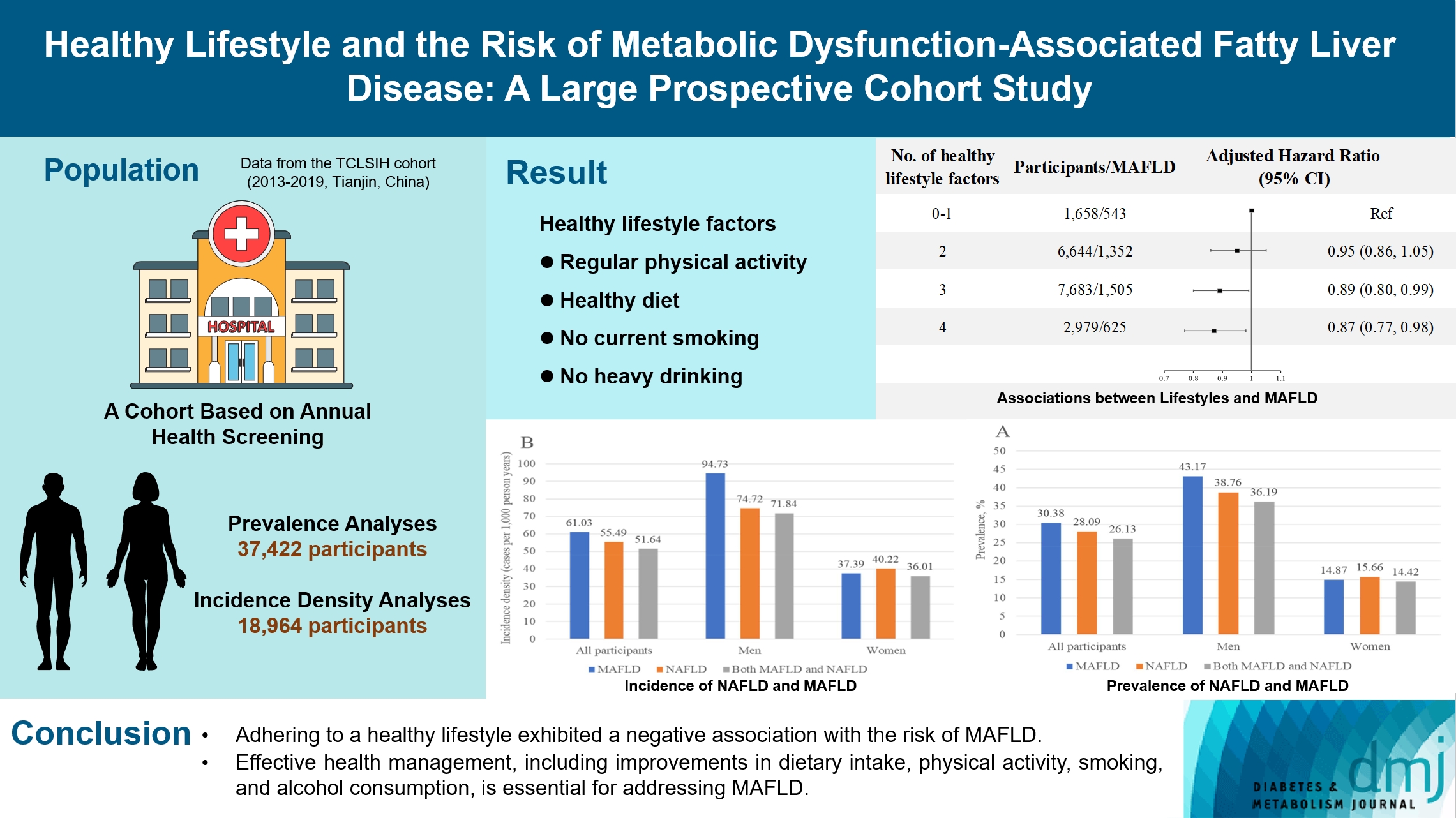
Background The incidence density of metabolic dysfunction-associated fatty liver disease (MAFLD) and the effect of a healthy lifestyle on the risk of MAFLD remain unknown. We evaluated the prevalence and incidence density of MAFLD and investigated the association between healthy lifestyle and the risk of MAFLD.
Methods A cross-sectional analysis was conducted on 37,422 participants to explore the prevalence of MAFLD. A cohort analysis of 18,964 individuals was conducted to identify the incidence of MAFLD, as well as the association between healthy lifestyle and MAFLD. Cox proportional hazards regression was used to calculate the hazard ratio (HR) and 95% confidence interval (CI) with adjustments for confounding factors.
Results The prevalence of MAFLD, non-alcoholic fatty liver disease, and their comorbidities were 30.38%, 28.09%, and 26.13%, respectively. After approximately 70 thousand person-years of follow-up, the incidence densities of the three conditions were 61.03, 55.49, and 51.64 per 1,000 person-years, respectively. Adherence to an overall healthy lifestyle was associated with a 19% decreased risk of MAFLD (HR, 0.81; 95% CI, 0.72 to 0.92), and the effects were modified by baseline age, sex, and body mass index (BMI). Subgroup analyses revealed that younger participants, men, and those with a lower BMI experienced more significant beneficial effects from healthy lifestyle.
Conclusion Our results highlight the beneficial effect of adherence to a healthy lifestyle on the prevention of MAFLD. Health management for improving dietary intake, physical activity, and smoking and drinking habits are critical to improving MAFLD.
Citations
Citations to this article as recorded by
The Role of Kupffer Cells and Liver Macrophages in the Pathogenesis of Metabolic Dysfunction-Associated Steatotic Liver Disease Ioannis Tsomidis, Angeliki Tsakou, Argyro Voumvouraki, Elias Kouroumalis Biomedicines.2026; 14(1): 151. CrossRef
Impact of healthy lifestyles on the risk of metabolic dysfunction‐associated steatotic liver disease among adults with comorbid hypertension and diabetes: Novel insight from a largely middle‐aged and elderly cohort in South China Jun‐Yan Xi, Yi‐Jing Wang, Xiao‐Heng Li, Nuo‐Min Sun, Rui‐Qi Ming, Hua‐Ling Yan, Huan‐Le Cai, Jian‐Jun Bai, Yi‐Ning Xiang, Jing Gu, Xiao Lin, Gang Liu, Yuan‐Tao Hao Diabetes, Obesity and Metabolism.2025; 27(5): 2800. CrossRef
Cholesteryl ester transfer protein gene variants and metabolic dysfunction-associated steatotic liver disease: genetic associations with steatosis in obese and lean individuals Asmaa AbdelFattah, Mahmoud Kattab, Hosny Abdel Ghany, Lamiaa Aly, Ahmed Mady, Aly Hamdi, Riham Soliman, Gamal Shiha, Nada El-Domiaty Egyptian Liver Journal.2025;[Epub] CrossRef
Research trends on the quality of life in patients with metabolic dysfunction-associated fatty liver diseases: a scientific metrology study Can Huang, Meng Chen, Yanfang Sun, Lin Zhang, Wei Liu Frontiers in Nutrition.2025;[Epub] CrossRef
The relationship between tobacco and non-alcoholic fatty liver disease incidence: a systematic review and meta-analysis of observational studies Jianxiang Jin, Yuping Zhang, Yiping Huang Frontiers in Medicine.2025;[Epub] CrossRef
Enhancing MAFLD Care: Efficacy of a Multidisciplinary Community Intervention on Self-Management and Hepatic Outcomes Huan-Jing Cai, Hai-Lun Liang, Lei-Yu Shi, Yi-Hui Rong, Jing Li, Yan Zhang, Rui-Fang Ma INQUIRY: The Journal of Health Care Organization, Provision, and Financing.2025;[Epub] CrossRef
Mechanistic investigation of DDT/DDE in MASLD/MASH pathogenesis: An integrated network toxicology and transcriptomics approach Yicheng Jiang, Yuancheng Shao, Jiaming Xue, Zhigang Chen, Qi Liu, Shuai Chen, Xihan Gu, Shufan Zhang, Liming Tang Ecotoxicology and Environmental Safety.2025; 307: 119390. CrossRef
Multiorgan crosstalk in MASLD/MASH: from hepatic pathogenesis to systemic complications Wenhua Bai, Zheng Zhu Frontiers in Endocrinology.2025;[Epub] CrossRef
Diagnostic indicators and lifestyle interventions of metabolic-associated fatty liver disease Tianzhu Chen, Xiang Qin, Jianping Jiang, Beihui He Frontiers in Nutrition.2024;[Epub] CrossRef
Sex differences in pathogenesis and treatment of dyslipidemia in patients with type 2 diabetes and steatotic liver disease Tatjana Ábel, Béla Benczúr, Éva Csajbókné Csobod Frontiers in Medicine.2024;[Epub] CrossRef
Associations of traditional healthy lifestyle and sleep quality with metabolic dysfunction-associated fatty liver disease: two population-based studies Jialu Yang, Qi Zhang, Wanying Zhao, Bingqi Ye, Siqi Li, Zhuoyu Zhang, Jingmeng Ju, Jialin He, Min Xia, Tiantian Xiong, Yan Liu Nutrition & Diabetes.2024;[Epub] CrossRef
Background We explored the association between continuous glucose monitoring (CGM) use and glycemia among adults with type 1 diabetes mellitus (T1DM) and determined the status of CGM metrics among adults with T1DM using CGM in the real-world.
Methods For this propensity-matched cross-sectional study, individuals with T1DM who visited the outpatient clinic of the Endocrinology Department of Samsung Medical Center between March 2018 and February 2020 were screened. Among them, 111 CGM users (for ≥9 months) were matched based on propensity score considering age, sex, and diabetes duration in a 1:2 ratio with 203 CGM never-users. The association between CGM use and glycemic measures was explored. In a subpopulation of CGM users who had been using official applications (not “do-it-yourself” software) such that Ambulatory Glucose Profile data for ≥1 month were available (n=87), standardized CGM metrics were summarized.
Results Linear regression analyses identified CGM use as a determining factor for log-transformed glycosylated hemoglobin. The fully-adjusted odds ratio (OR) and 95% confidence interval (CI) for uncontrolled glycosylated hemoglobin (>8%) were 0.365 (95% CI, 0.190 to 0.703) in CGM users compared to never-users. The fully-adjusted OR for controlled glycosylated hemoglobin (<7%) was 1.861 (95% CI, 1.119 to 3.096) in CGM users compared to never-users. Among individuals who had been using official applications for CGM, time in range (TIR) values within recent 30- and 90-day periods were 62.45%±16.63% and 63.08%±15.32%, respectively.
Conclusion CGM use was associated with glycemic control status among Korean adults with T1DM in the real-world, although CGM metrics including TIR might require further improvement among CGM users.
Citations
Citations to this article as recorded by
The role of continuous glucose monitoring in improving glycemic control in adolescents with type 1 diabetes Minkyu Seo, Kyu Hyun Park, Ji Won Park, EunJeong Kim, Do young Shin, Eungu Kang, Hyo-Kyoung Nam, Young-Jun Rhie, Kee-Hyoung Lee Annals of Pediatric Endocrinology & Metabolism.2025; 30(5): 268. CrossRef
Real-World Continuous Glucose Monitoring Data from a Population with Type 1 Diabetes in South Korea: Nationwide Single-System Analysis Ji Yoon Kim, Sang-Man Jin, Sarah B. Andrade, Boyang Chen, Jae Hyeon Kim Diabetes Technology & Therapeutics.2024; 26(6): 394. CrossRef
Accuracy and Safety of the 15-Day CareSens Air Continuous Glucose Monitoring System Kyung-Soo Kim, Seung-Hwan Lee, Won Sang Yoo, Cheol-Young Park Diabetes Technology & Therapeutics.2024; 26(4): 222. CrossRef
Disparities in Diabetes Technology Uptake in Youth and Young Adults With Type 1 Diabetes: A Global Perspective Rebecca Baqiyyah Conway, Janet Snell-Bergeon, Kyoko Honda-Kohmo, Anil Kumar Peddi, Salbiah Binti Isa, Shakira Sulong, Laurien Sibomana, Andrea Gerard Gonzalez, Jooyoun Song, Kate Elizabeth Lomax, Ching-Nien Lo, Wondong Kim, Aveni Haynes, Martin de Bock, M Journal of the Endocrine Society.2024;[Epub] CrossRef
Navigating the Seas of Glycemic Control: The Role of Continuous Glucose Monitoring in Type 1 Diabetes Mellitus Jun Sung Moon Diabetes & Metabolism Journal.2023; 47(3): 345. CrossRef
Smart Insulin Pen: Managing Insulin Therapy for People with Diabetes in the Digital Era Jee Hee Yoo, Jae Hyeon Kim The Journal of Korean Diabetes.2023; 24(4): 190. CrossRef